
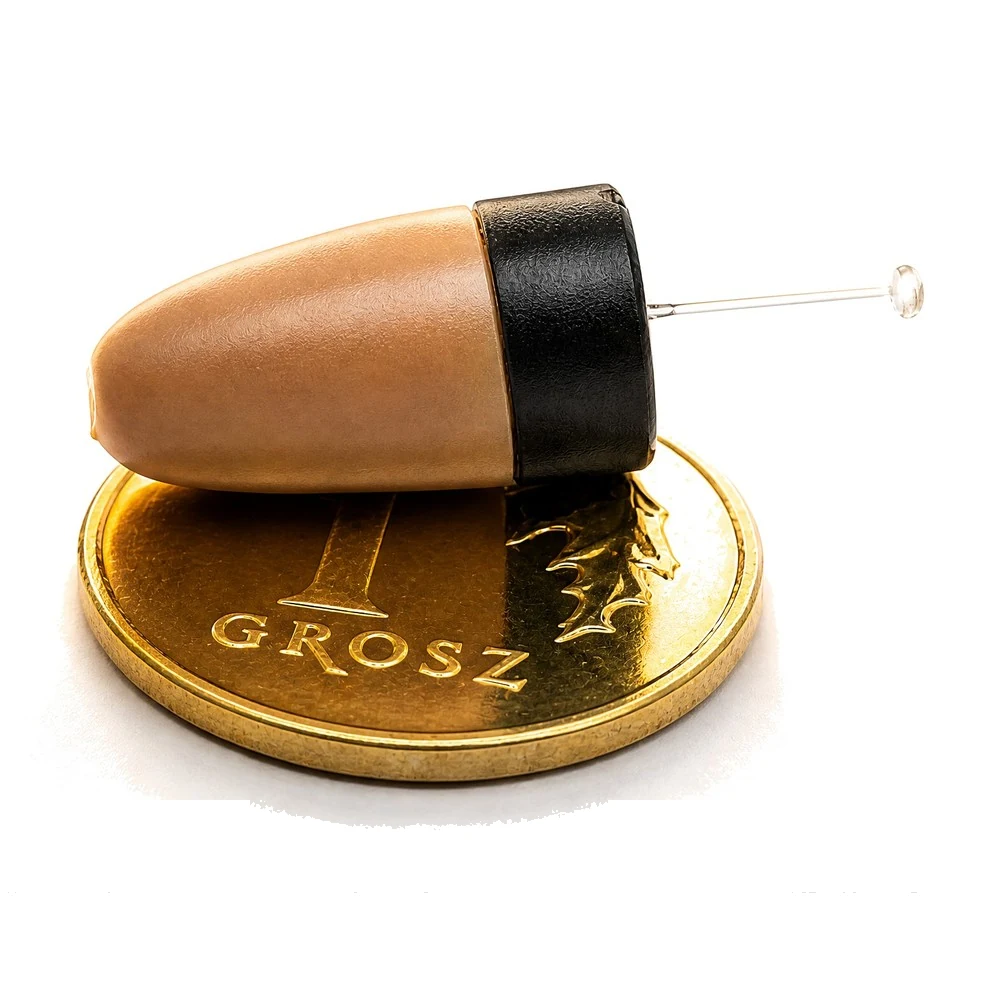
An earpiece smaller than a one-grosz coin
A micro earpiece hides completely inside the ear canal. It gets sound without a cable, from an induction loop worn under your clothes. Here we explain how it works and how to choose a kit.
- Phonea call or a recording
- Bluetooth or jack cable
- Neck loopunder your clothes
- magnetic field, a few dozen cm
- Micro earpiecein the ear canal
Choose a kit
Answer two questions and we will show you the kit worth starting with.
Our suggestion
TESLA Bluetooth NaNo kit
Our most popular kit: the TESLA NaNo earpiece and a Bluetooth loop. Works with any smartphone, no cables.
See the kit at hota.plMore on choosing: how to choose a micro earpiece
Three types of micro earpiece
They all work on the same principle but differ in size, volume and power supply.
Nano Most popular
A full induction earpiece with an amplifier in a housing that fits on a 1 grosz coin. Plays loud and fits any ear.
- Power
- silver-oxide battery
- Volume
- high
Standard induction
An older, larger version of the same design. Plays loud but hides less well in the ear.
- Power
- silver-oxide battery
- Volume
- high
Magnetic
A capsule with a magnet, no battery or electronics. Quieter, depends on the loop's power. Removed with a magnet.
- Power
- none, driven by the loop
- Volume
- lower

Why you cannot see it
An ordinary in-ear headphone sits in the outer ear, so everyone can see it. A micro earpiece is narrower than the ear canal and slides deeper, where it is already dark.
Colour helps too: the outer end is black or skin-coloured and blends into the shadow. There is no cable at all, because the loop hangs around your neck under your shirt.
From the guide
All articles (21)-
How does a micro earpiece work? Induction explained simply
No cable, no Bluetooth in the ear and no antenna. A micro earpiece relies on one of the oldest phenomena in electrical engineering, and that is exactly why it can be so small.
-
Types of micro earpiece: nano, induction and magnetic
In photos they all look alike: a small skin-coloured cone. Inside, though, they hide completely different designs, and that affects volume, comfort and price.
-
Induction loop for a micro earpiece: Bluetooth or jack?
A micro earpiece is only as good as the loop sending to it. Choosing between Bluetooth and a cable decides convenience, reliability and which devices the kit will work with at all.
-
How to choose a micro earpiece: 8 things to check
You rarely buy a micro earpiece, and you usually use it in situations with no room for surprises. Before adding a kit to your basket, go through this list.
-
Micro earpiece batteries: SR416SW, running time and replacement
The most common cause of a "broken" micro earpiece is a flat or badly fitted battery. Here is everything you need to know about powering the smallest electronics in your ear.
-
How to insert and safely remove a micro earpiece
A micro earpiece sits deeper in the ear canal than ordinary earphones. That is why you cannot see it, but it also calls for a few simple rules to keep it comfortable and safe.
Stories
All stories-
A radio in the helmet: how American football was ahead of its time in 1956
Long before anyone had heard of micro earpieces, a coach from Cleveland had the idea of speaking straight into a player's ear. It ended in eavesdropping, a ban and the idea's return almost 40 years later.
-
"The Thing": a battery-free bug hidden in a gift for an ambassador
A wooden seal, a gift from children, and seven years in the ambassador's study. Inside, a device with no battery and no wires, designed by the inventor of the first electronic musical instrument.
-
Acoustic Kitty and an embassy full of microphones: the strangest bugs of the Cold War
The Cold War was the golden age of bugging. Some ideas were brilliant, others so absurd that without declassified documents they would be hard to believe.
-
The history of the induction loop: from a 1937 patent to the micro earpiece
The loop you wear around your neck with a micro earpiece has almost two centuries of physics behind it and nearly 90 years of history as a device. It all started with helping people with hearing loss.