
The history of the induction loop: from a 1937 patent to the micro earpiece
The loop you wear around your neck with a micro earpiece has almost two centuries of physics behind it and nearly 90 years of history as a device. It all started with helping people with hearing loss.
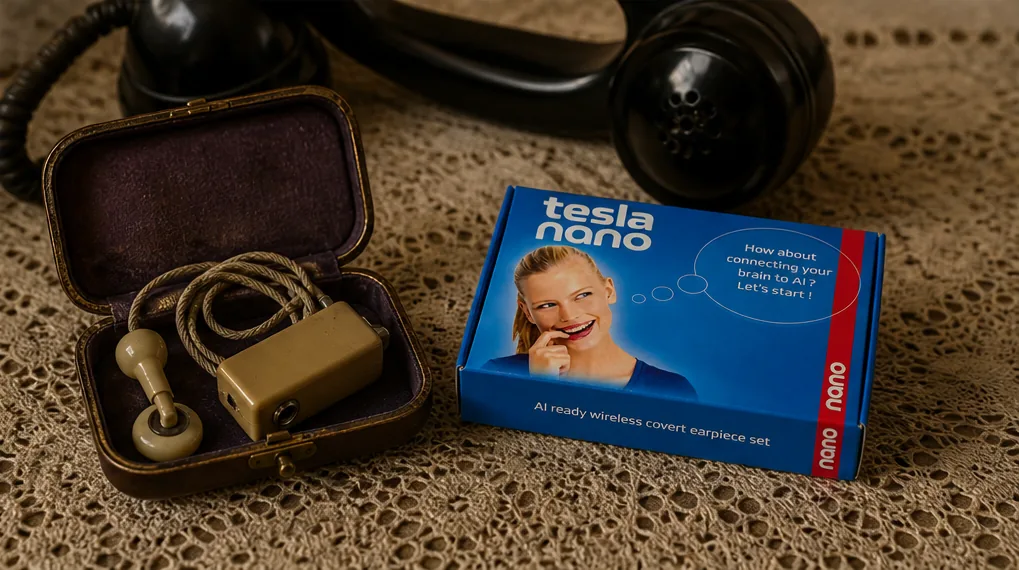
Every induction micro earpiece uses the same phenomenon: a changing magnetic field creates a current in a coil. It sounds like a physics lesson, because it is one. But the road from that phenomenon to an earpiece in the ear was a long one.
1831: Faraday and induction
Michael Faraday described electromagnetic induction in 1831: a change in the magnetic field near a conductor produces a current in it. Transformers, generators, wireless chargers and induction loops all work on this principle today. Details in How a micro earpiece works.
1937: Joseph Poliakoff's patent
For a hundred years nobody used induction to deliver sound to the ear. The British inventor Joseph Poliakoff did, patenting a hearing assistance system based on an induction loop in 1937. The key element was the so-called telephone coil. It was originally meant to pick up the magnetic field from a telephone handset and turn it back into sound, without the noise and distortion that arise when a hearing aid "listens" to a phone through its microphone.
1938: the first hearing aid with a coil
The patent was taken up by the British company Multitone. In 1938 it launched the VPM (Vest Pocket Model) hearing aid, considered the first with a telephone coil. It fitted in a waistcoat pocket, with a wired earphone leading to the ear. The name "telephone coil" was later shortened to telecoil, or "T-coil", and a switch marked T is still found on many hearing aids.
After the war: loops in halls and churches
Induction loops for people with hearing loss spread first in Europe and reached the USA after the Second World War. A wire laid around a hall and connected to the PA let a person with a hearing aid in T mode hear the speaker clearly, without echo. Today such places are marked with an ear symbol with the letter T (more on hearing loops).
Miniaturisation: from the waistcoat to the ear canal
The 1938 aid was carried in a pocket. The following decades brought steady shrinking of electronics: transistors, integrated circuits and ever smaller silver-oxide and zinc-air batteries. At some point a receiver with a coil, amplifier and battery fitted into a housing the size of a grain of sweetcorn. That is how the induction micro earpiece was born, sitting entirely inside the ear canal (how small it can be).
Today: Bluetooth plus induction
A modern kit combines two technologies. The loop connects to the phone via Bluetooth or cable. The last stretch, from the neck to the ear, is covered by the same induction Faraday described and Poliakoff put to work for sound (Bluetooth or jack). Nothing better has been invented, because a magnetic field can carry sound without a cable or antenna to an earpiece so small that no radio module would fit in it.
Sources
- Joseph Poliakoff, Wikipedia.
- History of Hearing Loops, Ampetronic.
- Audio induction loop, Wikipedia.