
How does a micro earpiece work? Induction explained simply
No cable, no Bluetooth in the ear and no antenna. A micro earpiece relies on one of the oldest phenomena in electrical engineering, and that is exactly why it can be so small.
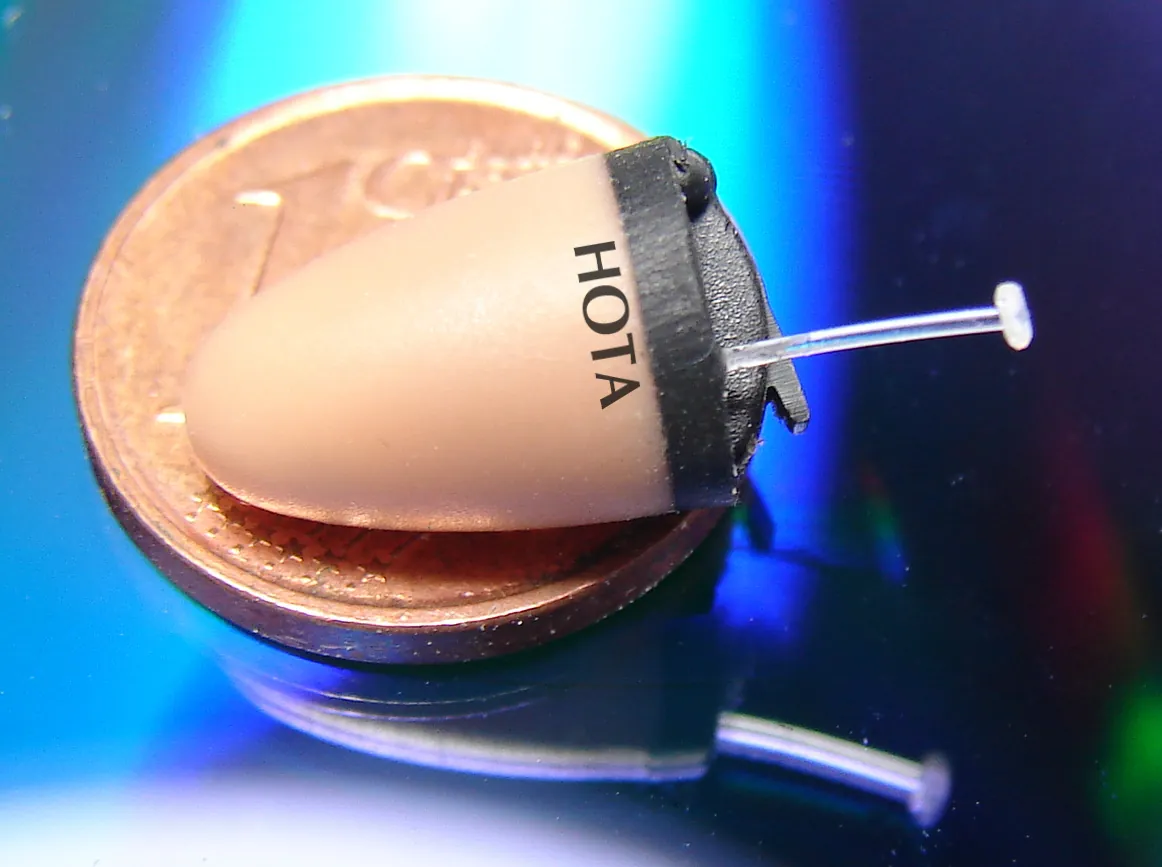
When people see a micro earpiece for the first time, they usually ask the same question: where does the sound come from if there is no cable or antenna? The answer is simpler than it seems. The whole kit works like a transformer stretched over a dozen or so centimetres: on one side there is the loop around your neck, on the other a tiny coil in your ear.
The principle in one sentence
A current flowing through a wire creates a magnetic field around it. When the current changes in time with the sound, the field changes too, and a changing magnetic field induces a current in any coil nearby. This is electromagnetic induction, described by Faraday in the 19th century. The micro earpiece simply picks up this "copied" current and turns it back into sound.
The sound path step by step
- The phone (or another source) sends sound to the loop, wirelessly via Bluetooth or through a jack cable.
- The induction loop contains a small amplifier. It passes the audio signal through the wire hanging around your neck, creating a changing magnetic field around it.
- The coil in the earpiece, wound on a core smaller than a grain of rice, "catches" this field. A very weak current in the shape of the original sound is induced in it.
- The amplifier in the earpiece, powered by a battery, boosts this signal to a level that can drive the transducer.
- The transducer (a miniature speaker similar to those in hearing aids) turns the current into air vibrations in the ear canal.

Why the earpiece must be close to the loop
A magnetic field weakens very quickly with distance. That is why the loop is worn around the neck rather than in a trouser pocket: the ear has to be within a few dozen centimetres of the wire at most. This limitation has an upside too: the signal cannot be picked up from the other side of the room, because it simply does not reach that far.
For the same reason, position matters. The earpiece receives best when its coil is roughly parallel to the field lines. In practice this means the loop should hang loosely around the neck, not be bundled up under your arm. If the sound fades when you turn your head, adjusting the wire is usually enough.
Why does such a small earpiece need a battery?
The energy reaching the earpiece through the magnetic field is tiny. It is enough to carry the sound information, but not enough to make that sound clearly audible. That is why induction micro earpieces contain an amplifier powered by a tiny silver-oxide battery, usually an SR416SW.
The exception is magnetic earpieces. They have neither a battery nor an amplifier: they are simply a magnet in a housing that vibrates in the loop's field. They are cheaper and even smaller, but quieter, and they need a stronger loop.
What about a microphone? How to speak through a micro earpiece
The earpiece only receives sound. To have a conversation you need a microphone, and that is always in the loop or in the phone. Bluetooth loops with a built-in microphone work like a headset: you answer the call and speak normally, and the microphone hidden near the loop module picks up your voice. In jack loops the microphone is usually in the cable, as in ordinary phone headphones.
We describe both solutions in Induction loop: Bluetooth or jack?
Where hissing and crackling come from
Since the earpiece picks up a magnetic field, it also picks up any other field nearby. Common sources of interference are:
- transformers and power supplies (in lamps, chargers, household appliances),
- electrical wiring in walls and floors,
- security gates and anti-theft systems in shops,
- the phone itself, if it is right next to the earpiece.
This usually shows up as a quiet buzz or hum. Most of the time it is enough to move away from the source or to put the phone further from your head. More causes and fixes are in Micro earpiece hissing, too quiet or silent.
Key points
- A micro earpiece receives sound through magnetic induction from a loop worn around the neck.
- The loop connects to the phone via Bluetooth or a jack cable.
- Induction earpieces have a battery and an amplifier; magnetic ones need no power but are quieter.
- The range is a few dozen centimetres, which is why the loop must be close to the ear.