
Morse code under the shirt and a phone in the toilet: hidden electronics scandals in chess
Chess is a game where a single hint can decide the result. No wonder some of the most inventive, and most embarrassing, attempts at cheating with hidden electronics happened in chess.
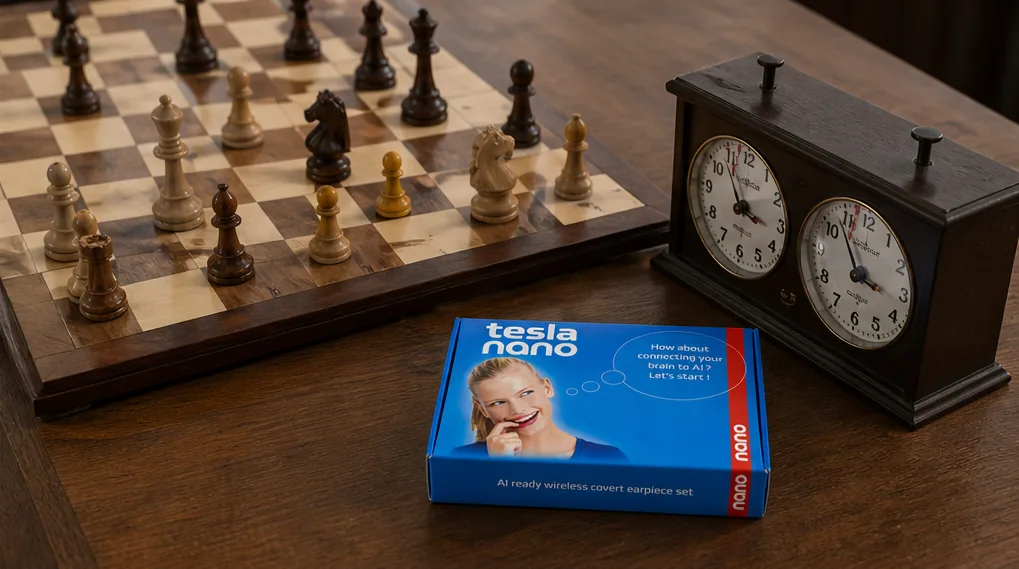
Ever since chess programs started playing better than people, cheating at chess has come down to one thing: how to secretly ask a computer for a move. Here are three well-known cases, reported by the media and confirmed by decisions of organisers or FIDE.
Imperia 2015: a camera in a pendant and Morse code
In September 2015, at the international chess festival in Imperia, Italy, a little-known player, Arcangelo Ricciardi, drew attention. He was ranked somewhere around 51,000th in the world, yet he won game after game, including against a French grandmaster.
The arbiters were worried by his behaviour: he blinked often and kept one hand under his armpit. According to media reports, under his shirt he had a pendant with a miniature camera, wires on his body and a small box under his armpit. An accomplice was most likely checking moves in a program and sending them back as Morse code signals. The player was expelled from the tournament.

Dubai 2015: a phone behind the toilet
A few months earlier, at the Dubai Open, Georgian grandmaster Gaioz Nigalidze kept going to the bathroom, always at critical moments of the game. His opponent complained. The chief arbiter found a phone hidden behind the toilet in the cubicle, covered with toilet paper, with a chess app analysing the current position.
FIDE banned Nigalidze for 3 years and stripped him of his grandmaster title. He kept his international master title.
Strasbourg 2019: the photo that ended a career
In July 2019, at a tournament in Strasbourg, 58-year-old grandmaster Igors Rausis was photographed in a toilet holding a phone. Rausis had surprised everyone with a rapid rise in the rankings over several years, which had raised suspicions. After the photo came out he admitted he had "played his last game". FIDE disqualified him and his grandmaster title was revoked.
Why they were caught
In all three stories it was not the technology that failed but the behaviour:
- Unnatural results. A player from the bottom of the rankings does not suddenly beat grandmasters.
- Repeated patterns. Frequent trips to the toilet, always in difficult positions.
- Body language. Blinking, a hand under the armpit, listening intently.
Today chess tournaments have their own procedures: electronics detectors at the entrance, a ban on phones in the playing area, delayed broadcasting of moves and statistical analysis of games that flags play "too similar" to a computer.
And micro earpieces?
A micro earpiece is a communication tool, like a phone or a radio. For a presenter, security staff or an interpreter it is completely legal and very useful (uses). In sport and in exams, where the rules forbid outside help, using one is cheating, with all the consequences shown above. The rules on exams in different countries are covered in Where exam cheating is a crime.