
Hearing loops for people with hearing loss vs. micro earpiece loops
Induction loops are associated with micro earpieces, but you are far more likely to meet them in an office, cinema or church. There they help people with hearing aids. Same principle, completely different purpose.
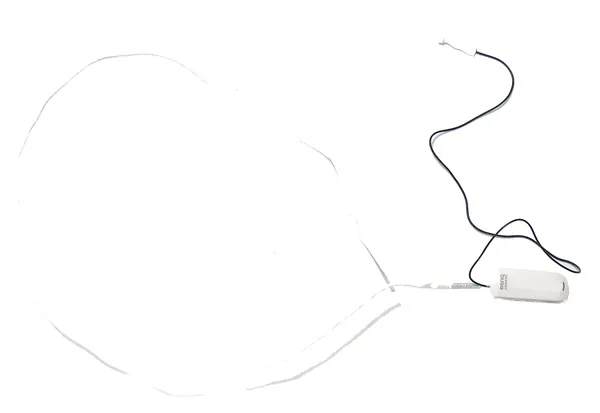
If you are looking for a loop for someone with hearing loss, you are in the right place. We explain how both kinds of loop work and how they differ. A micro earpiece loop will not replace a system for people with hearing loss, and vice versa.
The common principle: induction
Every induction loop is a wire carrying a current that follows the sound. A changing magnetic field forms around the wire, and a receiver with a coil, whether a hearing aid or a micro earpiece, turns it back into sound. We describe this in detail in How a micro earpiece works.
Hearing loops for people with hearing loss
This is a room installation: a wire laid around a hall, under the carpet or in the floor, or small loops at counters and service desks. It is connected to the speaker's microphone or the PA system. A person with a hearing aid switches it to T mode (telecoil) and hears speech directly in the aid, without room echo or crowd noise.
- Places with a loop are marked with the ear symbol with the letter T.
- The quality of such installations is set out in the standard EN IEC 60118-4, which specifies field strength and uniformity in the listening area, among other things.
- In Poland, the 2019 Act on ensuring accessibility for persons with special needs lists induction loops as one way of serving people with hearing loss in public bodies; other EU countries have similar accessibility rules.
- There are also personal neck loops for phones or TVs, for people with a T-coil hearing aid.
Micro earpiece loops
This is a personal transmitter worn around the neck and connected to a phone via Bluetooth or cable. Its field reaches a few dozen centimetres and is matched to the sensitivity of a micro earpiece, not a hearing aid. It is used for discreetly receiving calls by someone with normal hearing. A comparison of versions is in Induction loop: Bluetooth or jack.
The differences in a table
| Hearing loop | Micro earpiece loop | |
|---|---|---|
| For whom | people with a hearing aid or implant with a T-coil | hearing people who want to listen discreetly |
| Receiver | hearing aid in T mode | induction or magnetic micro earpiece |
| Range | a whole room or a service point | a few dozen centimetres from the neck |
| Sound source | speaker's microphone, PA, TV | phone, two-way radio, player |
| Standards | EN IEC 60118-4 | no dedicated standard, consumer equipment |
Will a micro earpiece help someone with hearing loss?
It will not replace a hearing aid. A micro earpiece is not a medical device and is not matched to a hearing loss. It does not boost selected frequencies or protect against overly loud sound the way an aid set up by an audiologist does. A person with hearing loss should seek advice from a doctor and an audiologist and, for phones or TV, choose a personal loop that works with their hearing aid.
Can the two kinds of loop interfere with each other?
Yes, although it is rare in practice. A micro earpiece near a hearing loop installation may pick up its sound, for example the voice from the room's PA. A hearing aid in T mode may in turn hear the call from the loop of someone standing right next to it. At a distance of a few metres the problem disappears.
Summary
- Both loops work on the principle of magnetic induction.
- A hearing loop is an installation or a personal loop for a hearing aid with a T-coil.
- A micro earpiece loop is a personal neck transmitter for people with normal hearing.
- A micro earpiece is not a hearing aid.